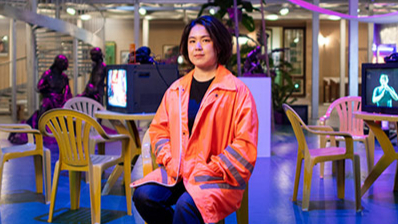
Cao Fei
Introduction
Cao Fei is a prominent contemporary Chinese artist renowned for her innovative and thought-provoking works that explore the intersections of reality and virtuality. Her artistic endeavors often delve into the utopian and dystopian potentials of modern-day cities, posing critical questions about the escapism offered by virtual platforms and the alienating effects of mechanized labor. Cao Fei's art is characterized by a unique blend of deadpan humor, surreal visions, and a keen insight into societal transformations, positioning her as a leading figure in the global art scene. Her ability to navigate complex realities and harness technology's possibilities speaks to her interest in shaping a collective future.
Early Life and Education
Cao Fei was born in Guangzhou, a bustling port city in Guangdong province, known for its significant role in China's economic boom as a manufacturing center. Her early life in Guangzhou, surrounded by the vibrancy and rapid industrialization of the region, greatly influenced her artistic sensibilities. Her father was a sculptor, which exposed her to art from a young age, and growing up in a city open to diverse cultural influences allowed her to assimilate global artistic styles and ideas.
Cao pursued her formal education at the Guangzhou Academy of Fine Arts, where she initially dreamed of becoming a filmmaker. During her time at the academy, she began experimenting with video art, culminating in her first significant work, "Imbalance 257," in 1999. This early film focused on the lives of recent graduates and garnered international attention, marking the start of her journey in the art world. Cao's education and upbringing in Guangzhou laid the foundation for her exploration of themes around industrialization, technology, and the interplay between human experiences and machine-driven environments.
Artistic Career
Major Works
Cao Fei's artistic career is marked by a series of innovative and critically acclaimed projects that explore the dynamic interplay between the physical and virtual worlds. One of her early breakthrough works is "Whose Utopia?" (2005–2006), a video installation created during her time working in a light bulb factory in Foshan. This piece combines elements of documentary and drama to depict the lives and dreams of factory workers, highlighting the contrast between their monotonous labor and personal aspirations. The work is a poignant commentary on the human condition within industrial settings.
In 2008, Cao launched "RMB City," a virtual city constructed within the online world of Second Life. This pioneering work of internet art reflects her interest in the possibilities of virtual spaces as platforms for artistic expression and social commentary. "RMB City" serves as a microcosm of contemporary urban life, blending elements of Chinese culture, capitalism, and futuristic visions.
Her later works continue to engage with themes of technological advancement and societal change. "Asia One" (2016–2018) is a fictional film set in an automated warehouse, exploring the intersection of human emotions and robotic efficiency. Accompanying this film is the documentary "11.11," which captures the logistics frenzy of China's annual shopping festival.
Style and Themes
Cao Fei's style is characterized by a seamless blend of documentary realism and fantastical imagination. She frequently employs multimedia installations, video art, and virtual reality to create immersive experiences that challenge viewers' perceptions of reality. Her works often use humor and irony to address serious issues, making them accessible to a broad audience.
A central theme in Cao's art is the exploration of social shifts and the impact of rapid technological changes on individuals and communities. She is particularly interested in the lives of marginalized groups and often features factory workers, cosplayers, and everyday people as subjects in her works. This focus on the human element within broader societal transformations underscores her commitment to capturing the stories and dreams of individuals navigating the complexities of modern life.
Exhibitions and Recognition
Cao Fei's work has been exhibited in prestigious art institutions worldwide, solidifying her status as a leading figure in contemporary art. Her exhibitions often provide immersive experiences that invite audiences to engage with multiple frames of reality and explore the intersection of art, technology, and society. Notable solo exhibitions include her shows at London's Serpentine Galleries and the Centre Pompidou in Paris, where she became the first Chinese artist to hold a solo exhibition.
In addition to solo exhibitions, Cao has participated in numerous international art fairs and biennales, further establishing her presence in the global art scene. Her work has been featured at the Tate Modern in London, the Guggenheim Museum in New York, and other significant venues, earning her widespread acclaim from both critics and audiences.
Impact
Cao Fei's impact on contemporary art is profound, as she continues to push the boundaries of artistic expression through her exploration of virtual realities and their implications for society. Her work resonates with a global audience, offering insights into the cultural and technological shifts shaping our world. By highlighting the stories of individuals within these broader transformations, Cao fosters a deeper understanding of the human experience in an increasingly digitized and interconnected world. Her unique approach to storytelling and her ability to capture the zeitgeist of modern society ensure her lasting influence on the field of contemporary art.








